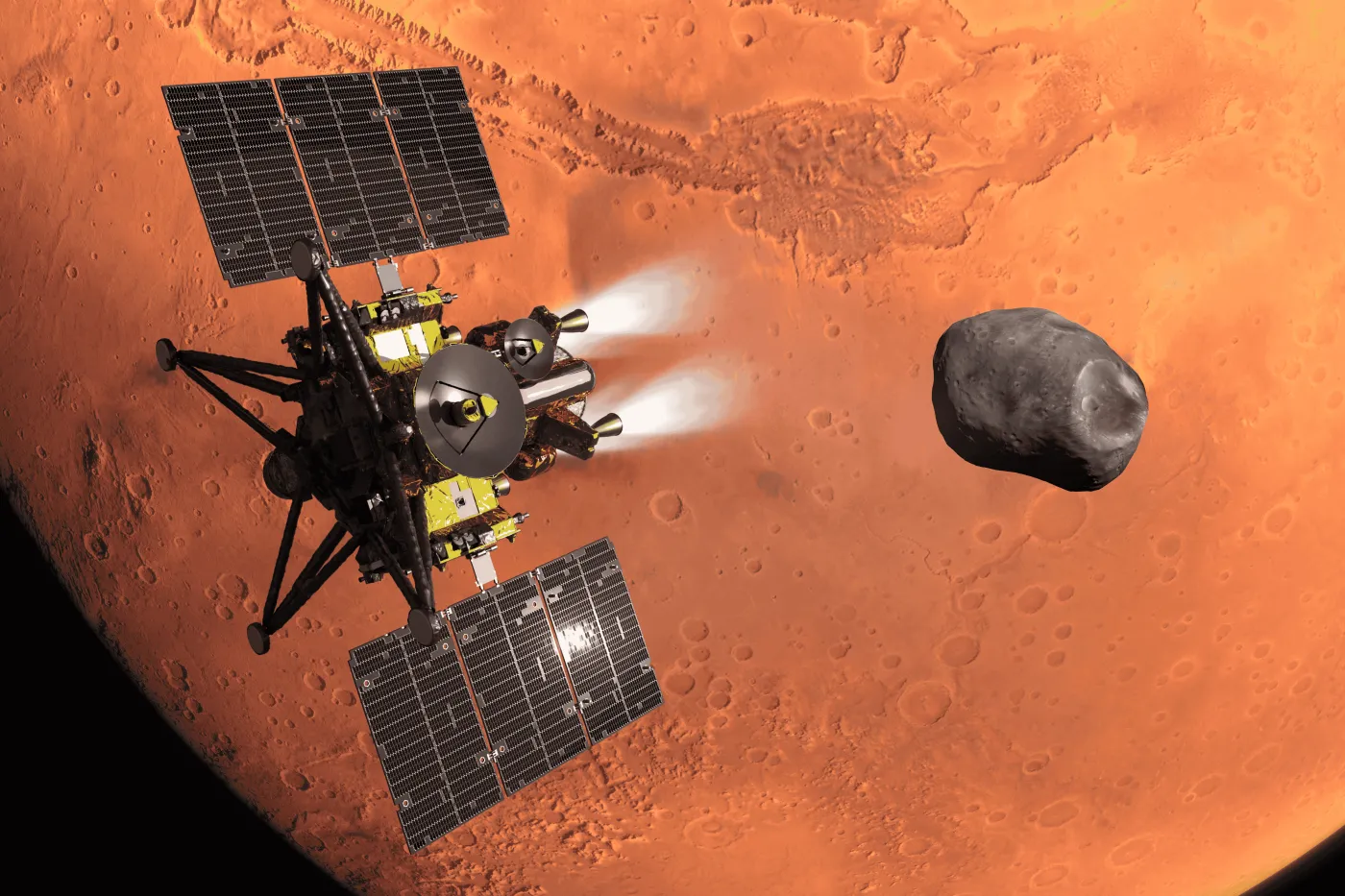
The Japanese space agency JAXA's most ambitious mission of the year soared into the Japanese dark sky on Oct. 19, 2026, at 10:40 p.m. EAT, bringing our species one step closer to some of the wonders of our solar system. The Martian Moons eXploration (MMX) H3 Launch Vehicle Flight No. 10 carries probes that were years in the making and a technology that help land on Mars' Phobos for the first time to acquire samples and retrieve them.
The mission will finally answer whether either of the two moons is an asteroid captured by Mars' gravity or if they are remnants of what scientists think was a huge collision with Mars when the solar system formed billions of years ago.
Besides the main outcomes of the MMX mission, the team will explore the possibility of using Phobos as a natural space station for crewed Mars exploration through observation of surface topography.
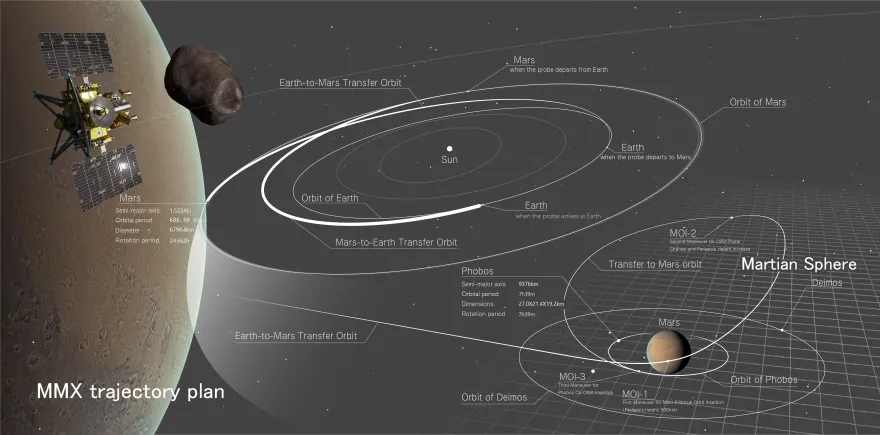
The MMX spacecraft consists of three modules and was launched from the Tanegashima Space Center, weighing 4,480 kg. It includes propulsion, exploration, and return modules. It is the first H3 mission to use a long fairing, with a five-year mission period and sample return expected by 2031. The science strategy team will investigate the planetary formation process and determine the gravity field. The mission aims to gather new data about the Martian sphere's evolution history and develop technology that will benefit future space exploration
The H3 Launch Vehicle is Japan's mainstay launch vehicle. We developed it to ensure that Japan can continue to access space independently, customers around the world will choose.
H3 project team manager Arita.
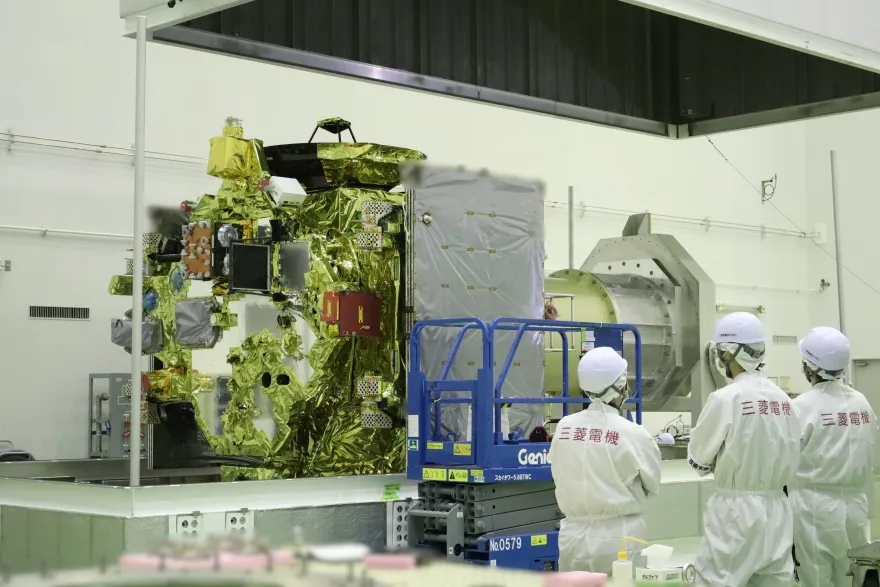
MMX has been hailed as an international partner effort including NASA, the German Aerospace Center (DLR), the French Centre National d'Etudes Spatiales (CNES), and the European Space Agency (ESA).
NASA says it contributes to the mission with the MEGANE spectrograph instrument, helping scientists “see what Phobos is made of by measuring neutrons and gamma rays emitted from the surface and determining its chemical elements.”

Under NASA's innovative research programs, Blue Origin’s Honeybee Robotics has partnered to design and fabricate a pneumatic sampler. It is designed to collect samples from Phobos' surface by mounting it on the MMX lander leg; the operation will take about 10 seconds using high-pressure nitrogen gas.
The Franco-German Idefix rover, developed by DLR and CNES, will land on Phobos to examine its surface and help identify a suitable landing site for the spacecraft. DLR contributes rover systems, software, and scientific instruments, while CNES developed key camera and service module systems. The rover is expected to operate on Phobos for about three months, with control centers in Cologne and Toulouse.
ESA said it has provided the spacecraft’s deep space communication equipment, including a transponder and power amplifier. ESA will also provide ground control stations to send commands and receive telemetry and science data from the spacecraft, which has its own specific research projects.

During the pre-launch briefing, JAXA’s MMX project manager, Kawakatsu Yasuhiro, explained mission objectives, including planetary science efforts to uncover the origin of a habitable environment by leveraging a new vantage point, as well as technological acquisitions for astronautics, robotics, and deep space communication capabilities.
Phobos (discovered in 1877) orbits Mars 230–400 million km away from Earth. Unlike our 4.5-billion-year-old Moon, its surface is rough, its diameter is only ~27 km, and it has 1/1000th of Earth's gravity pull. Compare that to the Moon surface gravity (1/6th), and it’s obvious how this difference can be both a challenge and a chance to forge new projects while answering theories surrounding the Martian moons.
By bringing home samples from Phobos, we hope to explore how the Martian moons were formed, how the Mars sphere evolved, and how the water and organic materials found on the terrestrial planets originated. We will also develop exploration technology that will be necessary for human exploration in the future.

This exploration project began almost ten years ago. From an engineering perspective, this is an ambitious plan and the mission has gained much international attention. With researchers and engineers from Japan and overseas working together to overcome the numerous challenges,
Martian Moons Exploration Project Team, Project Manager, Kawakatsu Yasuhiro
At least 10 grams of Phobos material will be brought back to Earth in the Sample Return Capsule, making the mission the first to land and return a sample from the Mars system to Earth.
Phobos is sometimes referred to as one of the most important unexplored bodies in the solar system.