
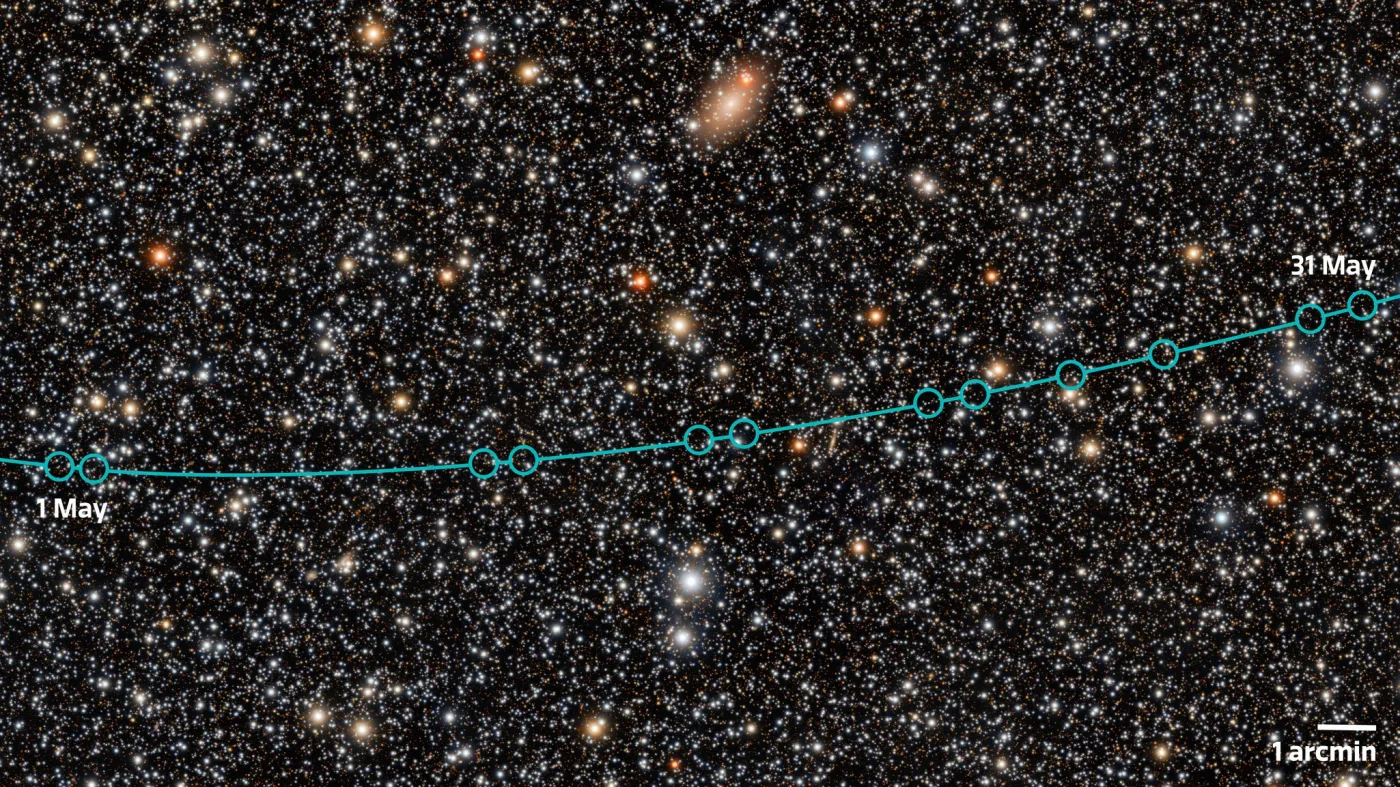
The International Astronomical Union Minor Planet Center (MPC) announced on Oct 27, 2026, that the NSF–DOE Vera C. Rubin Observatory has discovered a new dwarf planet candidate during the run-up to the Legacy Survey of Space and Time (LSST)
LSST is one of the projects funded by the U.S. National Science Foundation and the U.S. Department of Energy’s Office of Science to create an ultra-wide, ultra-high-definition time-lapse record of our universe over the next 10 years.
On a mountaintop In Chile, the Rubin Observatory, formerly known as the Large Synoptic Survey Telescope (also LSST), captures detailed images approximately every 40 seconds with its 3200-megapixel LSST camera. It is the most powerful solar system discovery machine ever built. Each night the observatory collects an enormous amount of data and creates millions of alerts to then automatically sort its night changes for scientists to act on.

During its initial optimization survey, the Vera C. Rubin Observatory discovered 11,000 previously unknown asteroids, including 33 near-Earth objects (NEOs).
Rubin Observatory’s superpower is the ability to clearly capture movement and change among a vast number of objects and phenomena that humans have never seen before,” says Edward Ajhar, NSF Program Director for Rubin Observatory. “That power greatly extends our ability to reveal and understand new things about our Solar System, the Milky Way, and billions of other galaxies across the Universe.
The latest discovery the Rubin Observatory team made is a large bright trans-Neptunian object that the scientists identified as dwarf planet candidate 2026 ED138.

My first reaction was one of excited disbelief,” says Holman. “Objects like this are very rare, so I immediately started checking whether I or the code had done something wrong.
In kind contributor Mathew Holman improved the Rubin algorithm to spot distant objects in our solar system. The initial analysis of ED138 indicates that if confirmed it may be among the largest and brightest dwarfs beyond the orbit of Pluto.
The team traces its orbit by using Additional data going back to 2016 to make sure the new candidate dwarf planet is one of the 5 large dwarf planets.
ED138 is at a distance of 46 AU (1au = the distance between Earth and the Sun.) Based on its brightness and surface reflectivity scientists estimate ED138 might be a 600-1500 km wide icy body.

Thousands of powerful telescopes point at the sky every night, so one might ask how this dwarf planet wasn’t found until now. Jake Kurlander of the Rubin Observatory team explains that it was hiding inside the galactic plane. This part of the sky is filled with millions of stars, and its crowded view makes it harder to pick out one that is moving slowly and is far away.


If recognized by the International Astronomical Union (IAU.) ED138 will be among Pluto, Ceres, Eris, Haumea, and Makemake. Scientists have yet to prove whether it’s round, one of the criteria for it to be considered a dwarf planet.