


Dark matter and Dark energy are some of the most elusive puzzles in physics. The universe is abundant with matter—there are trillions of galaxies and stars. Even then, it barely makes up 5% of the universe. The vast majority of the universe is dark matter and dark energy, which account for roughly 27% and 68% respectively. Detecting them, however, remains a mystery to be solved.
What is Dark Matter?
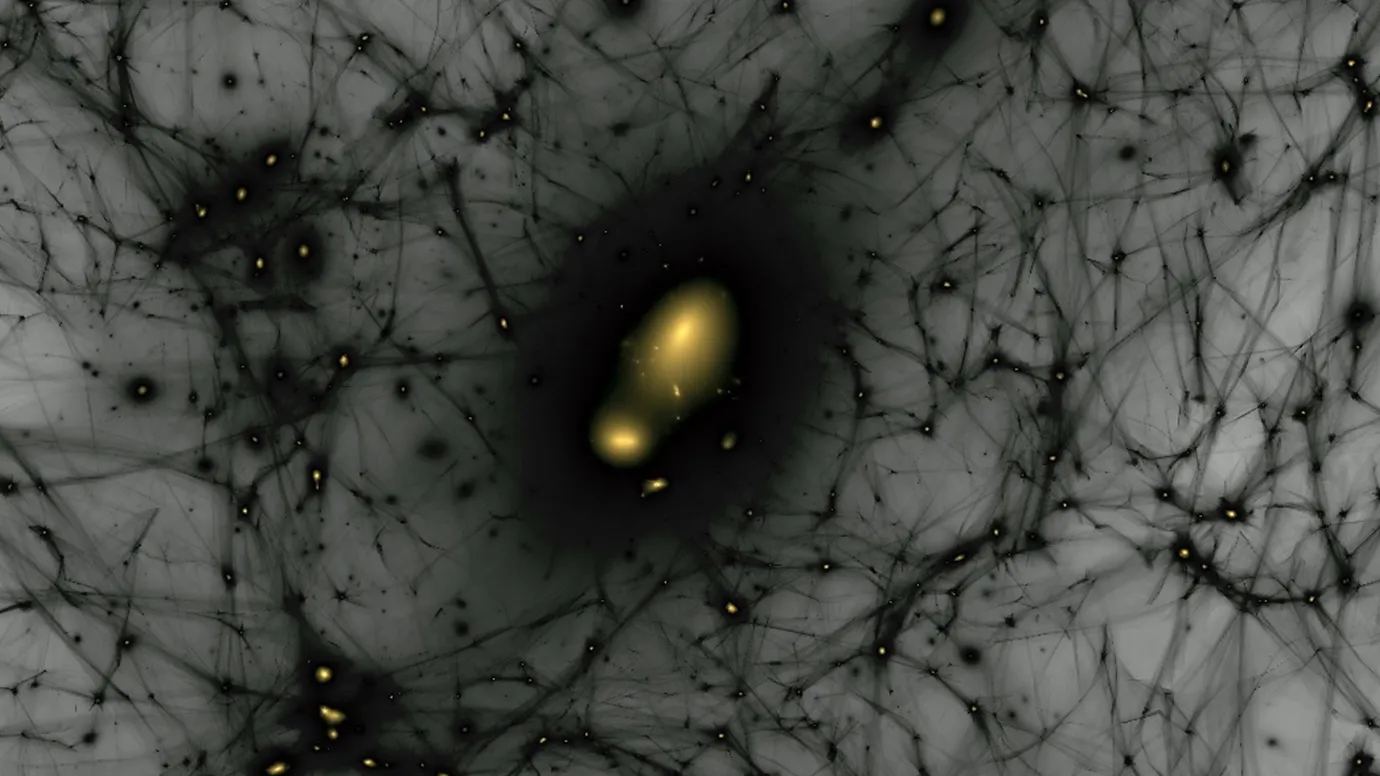
Dark matter is an invisible and hypothetical type of matter that does not interact with any electromagnetic radiation. Scientists infer the existence of this substance based on indirect observations and reasoning. One example is that stars at the outer edges of galaxies move much faster than expected based only on visible matter, pointing to extra, unseen mass.
Another piece of evidence is gravitational lensing (bending of light due to gravity) by dark matter. Scientists working with the James Webb Space Telescope have detected light being bent when there is no visible large piece of matter in its path. This suggests there must be a dense cluster of invisible dark matter bending the light due to immense gravity.
Several alternatives have been put forward to explain this discrepancy, but none of them have been able to fully account for all observations. Hence, scientists hypothesized the existence of matter that we cannot see, matter that does not interact with electromagnetic waves but pulls on ordinary matter through gravity—dark matter.
Proposed candidates for dark matter
There have been a handful of theories to explain dark matter, all with their successes and shortcomings.
Primordial Black Holes (PBHs): This theory suggests dark matter is made of billions of ancient black holes. Microlensing telescope surveys have watched thousands of distant stars to see if invisible black holes warp their light. These surveys have ruled out PBHs across almost every mass range (from sub-planetary to massive star-sized). If they exist as dark matter, they must hide in an incredibly narrow, unproven mass window (roughly the mass of a large asteroid).

Sterile Neutrinos: Normal neutrinos are real, ghostly particles that exist but are far too light to make up all of dark matter. Sterile neutrinos are hypothetical, heavier "cousins" that interact almost exclusively through gravity. However, they are virtually impossible to catch in a laboratory. We can only hunt for them if they occasionally decay into X-rays, but space telescopes haven't found a definitive signature.
Axions (and Ultralight Axions): Unlike sterile neutrinos, which are heavier particles hunted by space telescopes, axions are ultralight, wave-like particles searched for in ground labs using powerful magnetic fields. They are exceptionally difficult to find because their mass is microscopic (trillions of times lighter than an electron). While experiments like the ADMX Haloscope are slowly ruling out certain mass ranges, they remain entirely undetected.
WIMPs (Weakly Interacting Massive Particles): These are heavy, slow-moving subatomic particles that interact via gravity and the weak nuclear force. For decades, WIMPs have been the leading theory because they perfectly explain how dark matter behaved during the birth of the universe and why there is so much of it. Some of the largest experiments in physics target the detection of WIMPs.
Detection of WIMPs
‘Detection’ in this context refers to capturing a non-gravitational interaction between a dark matter particle and normal matter inside a controlled laboratory experiment. Scientists are looking for direct evidence like a flash of light, a pulse of heat, or an electric charge resulting from the collision of a dark matter particle and regular matter. If such a collision is detected, scientists will be able to deduce the mass of the hypothetical particle(s) making up dark matter, the velocity at which they move, and other properties. A good analogy is neutrino detection experiments (watch below).

Because dark matter interacts so weakly, these experiments must be conducted deep underground beneath dense rock to maximize the chance of detecting a rare collision while shielding against interference. On the Earth's surface, detectors are constantly bombarded by a noisy background of cosmic radiation, which completely overshadows subtle particle signals. Placing experiments miles beneath solid rock filters out this background interference, creating an ultra-quiet environment. Inside this isolated environment, scientists fill massive tanks with dense target material like liquid xenon. This dense target maximizes the interaction probability, giving ghostly dark matter particles a chance to collide with a xenon nucleus and be recorded.
One of the leading experiments aiming to achieve this is the LUX-ZEPLIN (LZ) experiment. It is the world's most sensitive dark matter detector, operating nearly a mile deep inside a former South Dakota gold mine in the U.S. Formed by merging the prominent American LUX and British ZEPLIN research groups, this international collaboration stands on decades of particle-hunting history. It occupies the legendary underground cavern where Ray Davis first discovered solar neutrinos in the 1960s. Today, as a second-generation direct-detection experiment, LZ's primary mission is to catch a WIMP physically colliding with normal matter. Utilizing a central tank filled with ten tons of ultra-pure liquid xenon, the detector records rare, microscopic flashes of light to catch the universe’s most elusive ghost.
Recent reports

On September 1, 2026, the international LUX-ZEPLIN (LZ) collaboration reported an intriguing result at the 2026 TeV Particle Astrophysics conference in Japan, announcing the detection of an unexplained particle interaction. Analyzing 220 days of live data collected between March 2023 and April 2024, researchers revealed a single particle collision event. What makes this specific flash of light so captivating is its higher energy profile compared to the ultra-low energy thresholds where physicists traditionally expected the simplest WIMP models to appear.
While the anomaly currently sits at a 2.6-sigma statistical significance (meaning it has roughly a 1-in-200 (0.5%) chance of being a background fluke and does not meet the strict 5-sigma threshold required to claim an official discovery), it stands as one of the most compelling hints of a potential direct dark matter interaction ever recorded by LZ. If this event is validated by upcoming experimental runs, it would suggest that dark matter is not only real, but is composed of heavy particles weighing a massive one teraelectronvolt (TeV), more than 200 times the mass of a proton—defying previous expectations. Researchers emphasize that this is a hint rather than a confirmed detection. In the coming years, the LZ detector will run to collect more data and determine whether similar events repeat.