The universe, which came into existence at least 13.8 billion years ago, has been expanding ever since, and that expansion is accelerating (although there have been recent disagreements about exactly how fast, the consensus among the scientific community is unchanged). However, no matter how large the universe gets, We will only be able to see a fraction of it: the observable universe. The only way around this would be to travel faster than light, which, as far as we know, the laws of physics forbid.
The expanding universe
The universe is expanding, but where? What is it expanding into? This is a common question among people who hear about the expansion of the universe for the first time, and the answer is less glamorous than most expect. The universe is not expanding into anything. Rather, space itself is stretching, much like a rubber band, and creating more room between objects.
How do we know the universe is expanding?
The universe is built from the same ingredients everywhere. Stars burn hydrogen wherever they are, heavy elements like iron are forged in stellar cores, and so on. That means the light from a distant galaxy should carry the same fingerprints as light from a lab burning Hydrogen on Earth. Every element absorbs and emits light at very specific wavelengths, forming a pattern of spectral lines. Hydrogen, for example, has a bright red line (called H-alpha) at exactly 656.3 nm.
Now suppose you point a telescope at a distant galaxy and find that its hydrogen line shows up at 722 nm instead of 656.3 nm. Every other line in its spectrum is shifted by the same fraction too. No other element matches this exact pattern and nothing about hydrogen has changed, so something happened to the light itself. The cause of this shift (known as “redshift”) is space stretching while the light travels through it.
A helpful, though imprecise, analogy is to imagine standing on two legs while the ground beneath you starts to stretch. Soon you would find your legs spread wider than before. Similarly, light waves are stretched by the expansion of space, so the distance from one peak of the wave to the next (the wavelength) ends up longer, and hence the spectral lines are shifted. Scientists use this and other data to conclude that the universe is expanding.
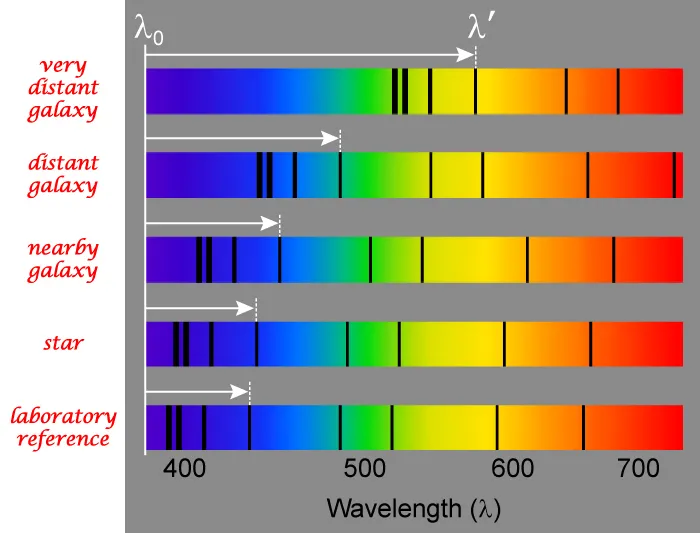
But how fast? Almost every distant galaxy is redshifted, and the farther away it is, the larger the redshift. This pattern is known as Hubble’s law. It means a galaxy 100 million light-years away is receding from us faster than a galaxy 60 million light-years away.
There are two main ways of measuring the present rate of expansion, called the Hubble constant, and they disagree slightly but both agree that the universe is expanding.
The limits of what we can see
If galaxies recede faster the farther away they are, there must be a distance beyond which they recede faster than light. You might conclude that anything past that point is lost to us forever, no matter how advanced our tools get. It turns out the truth is a bit more subtle, and more interesting.
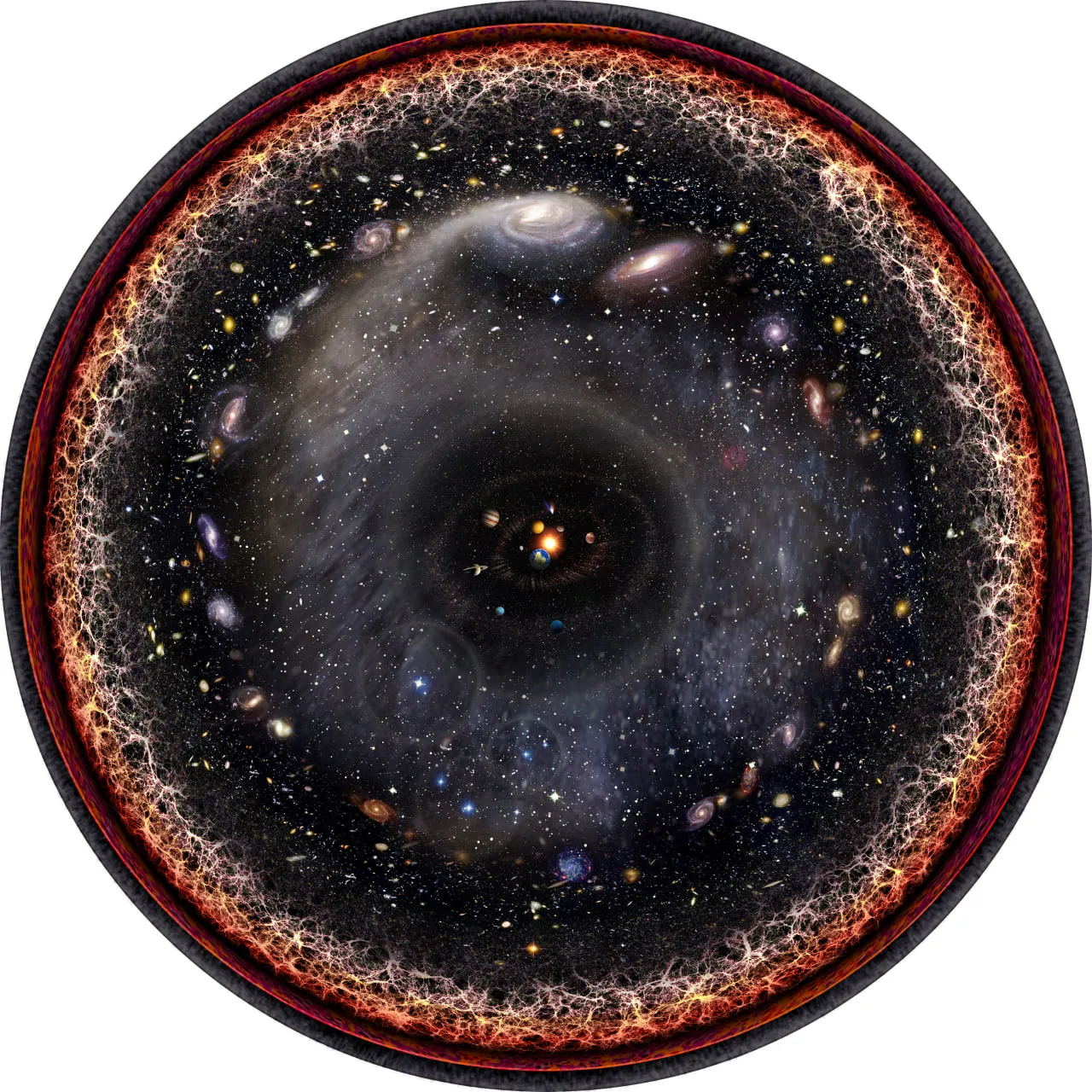
The “observable universe” is a familiar term. It describes the region of space from which light has had time to reach us since the beginning, and beyond which we can’t see anything yet. It is a sphere about 46.5 billion light-years in radius, and astronomers call its edge the particle horizon. However, a common misconception is that if a galaxy 46 billion light-years away emitted light today, we would be able to detect it after enough time had passed. As we’ll see, we won’t.

It is tempting to think the edge of the observable universe is where galaxies start receding faster than light, but that is not quite right. Two different boundaries hide behind the phrase “the limit of what we can see,” and they answer two different questions. The first asks: what have we already seen? That is the particle horizon. The second asks: what will we ever be able to see? That is the event horizon, and here the expansion of space really does play the starring role.
Start with the first boundary. The universe is 13.8 billion years old, so light from any source has had at most 13.8 billion years to reach us. You might expect that to make the observable universe 13.8 billion light-years in radius, but it is about 46.5 billion. The reason is that space kept stretching while the light was in transit. The earliest light we can see, the cosmic microwave background, was released about 380,000 years after the Big Bang. Before that, the universe was an opaque, glowing fog, so nothing earlier can reach us as light.
That light has a surprising story. When it was released, the matter that emitted it was only about 40 million light-years from where we are now. At that time, Space was expanding much faster than the speed of light. However, as experimental evidence shows, this speed has been decreasing towards a constant value. However, due to the expansion of space, in the 13.8 billion years since the emission of that light, the matter that emitted that light has been carried to roughly 46.5 billion light-years away, while the light itself has been arriving at our telescopes the whole time. So when we look at the most distant objects, we are not seeing where they are. We are seeing where they were.
The second boundary is the one that is easy to confuse with the first. Beyond a distance of about 14 billion light-years (the Hubble sphere), space is stretching so quickly that galaxies recede from us faster than light. However, this is still not the boundary beyond which light emitted today would never reach us. Although Space is expanding at a rate faster than speed of light at that point, over time it is expected to slow down and fall just below light speed, allowing light to reach us after a long time. The real point of no return, one where the expansion of space will never fall below the speed of light, is a slightly farther line, the event horizon, at about 16 billion light-years. Light emitted today from beyond it will never reach us, no matter how long we wait.
A galaxy now 20 billion light-years away is already outside our event horizon, yet we can see it because we are receiving light it sent billions of years ago, when it was much closer. Its present self is permanently out of reach, but its past self is still arriving. Think of a friend who moves away at an ever-increasing speed: the letters they wrote early on still reach you, but anything they write today never will. Over time, the light from these galaxies will stretch to longer and longer wavelengths and fade, and one by one they will slip out of view. Check out the PBS series attached below for visual demonstrations.
Our galactic neighbors
A natural question to ask is: if the universe is expanding, will we eventually drift apart from all our galactic neighbors? The answer depends on what dark energy does over time. If it is a cosmological constant, as the standard picture assumes, gravity wins at relatively short distances (10–20 million light-years). Hence, our immediate surroundings will not drift further apart.
To see why gravity wins nearby, it helps to remember that expansion is not a force pushing objects apart. It is the stretching of space itself, and it only shows up where nothing else is holding things together. Atoms, planets, stars, and galaxies are all held together by forces far stronger than the expansion, so none of them are growing. The same is true at larger scales. Andromeda is about 2.5 million light-years away, and if it were simply carried along with the expansion, it would recede at roughly 55 km/s. Instead, we observe it approaching at about 110 km/s. Gravity first has to cancel that outward drift and then some, so its pull is even stronger than the 110 km/s suggests. The expansion is present, but it is overwhelmed.
Our galaxy and Andromeda are the two largest members of the Local Group, a gravitationally bound family of several dozen galaxies spread across about 10 million light-years, including the Triangulum galaxy and many small dwarf galaxies. Because the group is bound, it will stay together as the rest of the universe moves away. Galaxy clusters like Virgo, about 55 million light-years away, are too far for gravity to hold on to us against the expansion. Over time, these distant structures will recede, and the farther away they are, the faster they will go. As other galaxies recede and their light stretches to ever longer wavelengths, they will fade from view, and a far-future astronomer would see only a lonely sky with relatively few galactic neighbors.
All of this rests on dark energy staying constant, and that is not guaranteed. If it strengthens over time, the outcome is far more dramatic. In the most extreme version, called the Big Rip, the expansion would eventually overpower even bound structures. Galaxy clusters would come apart first, then galaxies, then solar systems, and finally planets, stars, and atoms in the last moments. Current measurements do not favor this. In fact, recent results from the DESI survey hint at the opposite: that dark energy may be weakening over time. That is still tentative, but it would mean the universe is not quite following the simple cosmological-constant picture. Either way, the fate of the universe depends on the nature of dark energy, one of the biggest unanswered questions in physics.