
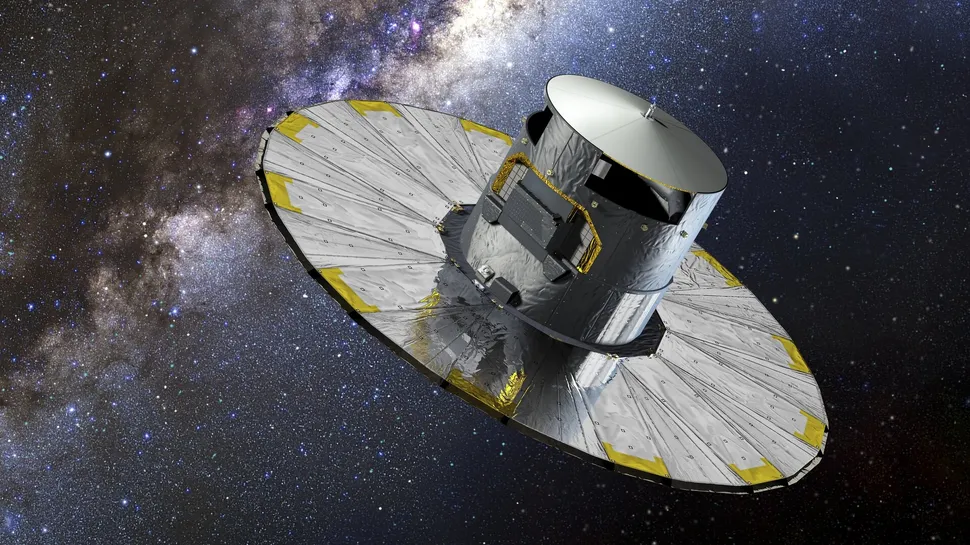
The European Space Agency’s Gaia telescope has discovered seven potential "baby" planets by detecting the subtle gravitational wobbles of stars still in their infancy. By surveying 98 young stellar systems, researchers bypassed thick clouds of cosmic dust to find these hidden worlds, marking a major milestone in understanding how planetary systems form. This breakthrough provides a direct link to the early history of our own Solar System and establishes new targets for the James Webb Space Telescope to study in detail. "Image: An illustration of the Gaia spacecraft as it makes its observations. (Image credit: ESA)"
In a significant leap for astronomy, the European Space Agency's (ESA) Gaia space telescope has successfully identified hidden companions, including potential "baby" planets, inside the chaotic nurseries where planetary systems are born. This breakthrough offers a rare look at the earliest stages of planetary evolution, a period that has long been obscured by cosmic dust and gas.
The study, led by Miguel Vioque at the European Southern Observatory and published in Astronomy & Astrophysics, focused on 98 "transition discs," which are protoplanetary systems featuring mysterious, donut-like holes in their dust clouds. By leveraging Gaia's unprecedented precision, the team found significant evidence of unseen companions in 31 of those systems (32%).
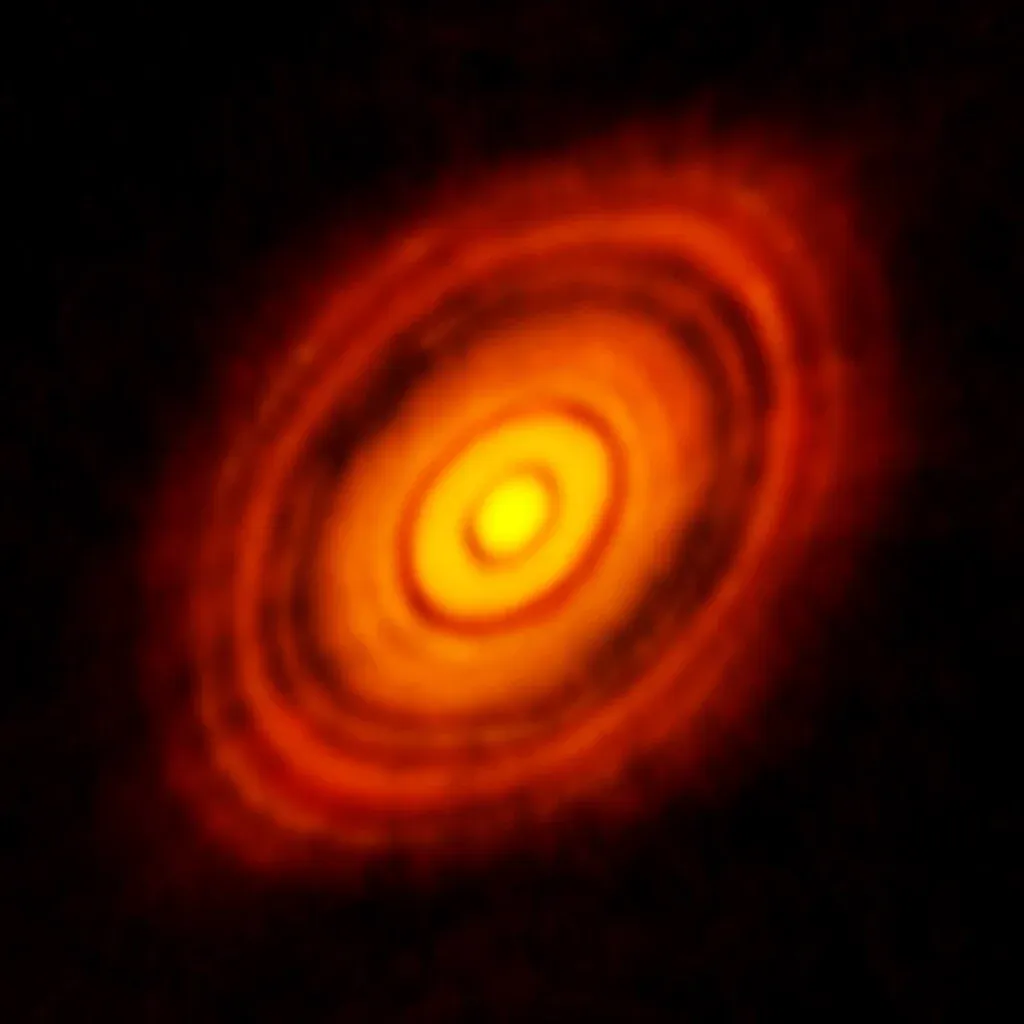
Protoplanetary disk around HL Tauri (Credit : ALMA)
The "Invisible Dance" of Star Formation
For decades, observing planets in their infancy has been one of the greatest challenges in the field. Planets form within protoplanetary discs, swirling clouds of matter surrounding newborn stars. Direct observation is often impossible because the thick dust blocks visible light.
Gaia overcame this by ignoring the dust and focusing on the stars. Using a technique called Proper Motion Anomaly, the researchers compared the stars' velocities across data from Gaia DR2 and DR3. They looked for the tell-tale "wobble," which is the gravitational tug of a hidden object pulling the star slightly off course.
"We assessed the impact of disc gravity, accretion, and starspots," the authors noted, confirming that the detected wobbles were indeed caused by massive companions rather than stellar hyperactivity. To validate their method, the team successfully recovered 85% of previously known companions in the sample.

The Discovery by the Numbers
The research revealed a diverse range of companions lurking within these dusty discs. Most of the detected objects were massive (above 30 Jupiter masses), but several fell within the planetary regime.
- Planetary-Mass Objects (less than 13 Jupiter masses): 7 candidates were identified, including in the systems HD 100453, PDS 70, and MP Mus.
- Brown Dwarfs & Stars: The majority of detections were "failed stars" or stellar binaries, placing them in the brown dwarf or stellar mass regime.
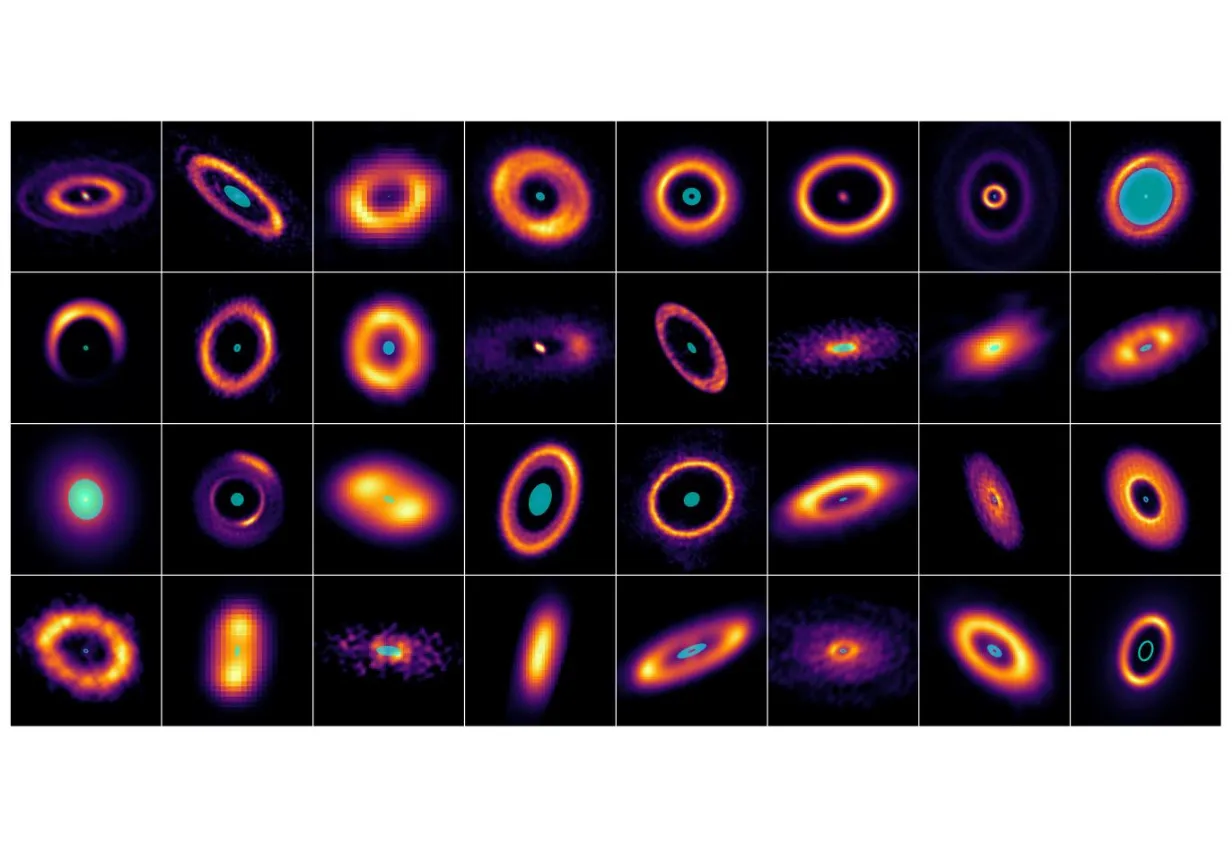
A collage of 32 glowing discs on a black background. Each disc shows concentric rings in vivid colours: purple, orange, and yellow, with bright cyan centres. The discs vary in size and orientation, creating a striking pattern of circular and elliptical shapes. (Credit : ESO, ESA/Gaia/DPAC, M. Vioque et al.)
A Cosmic Plot Twist: The Mystery of the Missing Carvers
Perhaps the most intriguing finding is a discrepancy in the "construction" of these solar systems. Astronomers generally assume that the large holes (cavities) seen in these discs are carved out by the planets residing in them.
However, the study found that 53% of the detected companions are orbiting too close to their stars to be responsible for the massive cavities observed by radio telescopes. This suggests a "Russian Doll" scenario where Gaia detected a massive inner companion, but there may be another, smaller planet lurking further out that is silently sculpting the disc's edge.
A Mirror to Our Own History
To visualize these findings, ESA released a striking collage of 32 glowing discs captured by the Atacama Large Millimetre Array (ALMA). In these images, Gaia's predicted locations for the hidden companions are marked in cyan.
Notably, the collage includes a reference image of our own Sun as it would have looked at just one million years old. By showing Jupiter's predicted orbit at that age, the study provides a direct comparison between these distant nurseries and the origins of our own home.
The Future of Planet Hunting
The implications of this study are revolutionary because of Gaia's scale. While ground-based telescopes can only study a few stars at a time, Gaia's all-sky survey allows for the statistical analysis of hundreds of systems simultaneously.
The next steps for the scientific community include James Webb Space Telescope (JWST) follow-ups using infrared sensors to peer through the dust and directly image the planetary candidates identified by Vioque's team. Furthermore, the study suggests that transition discs are not just binary systems. They host as many companions as random field stars, challenging current theories on how binary stars affect disc evolution.
This research, titled "Astrometric view of companions in the inner dust cavities of protoplanetary discs," has been accepted for publication in Astronomy & Astrophysics.