

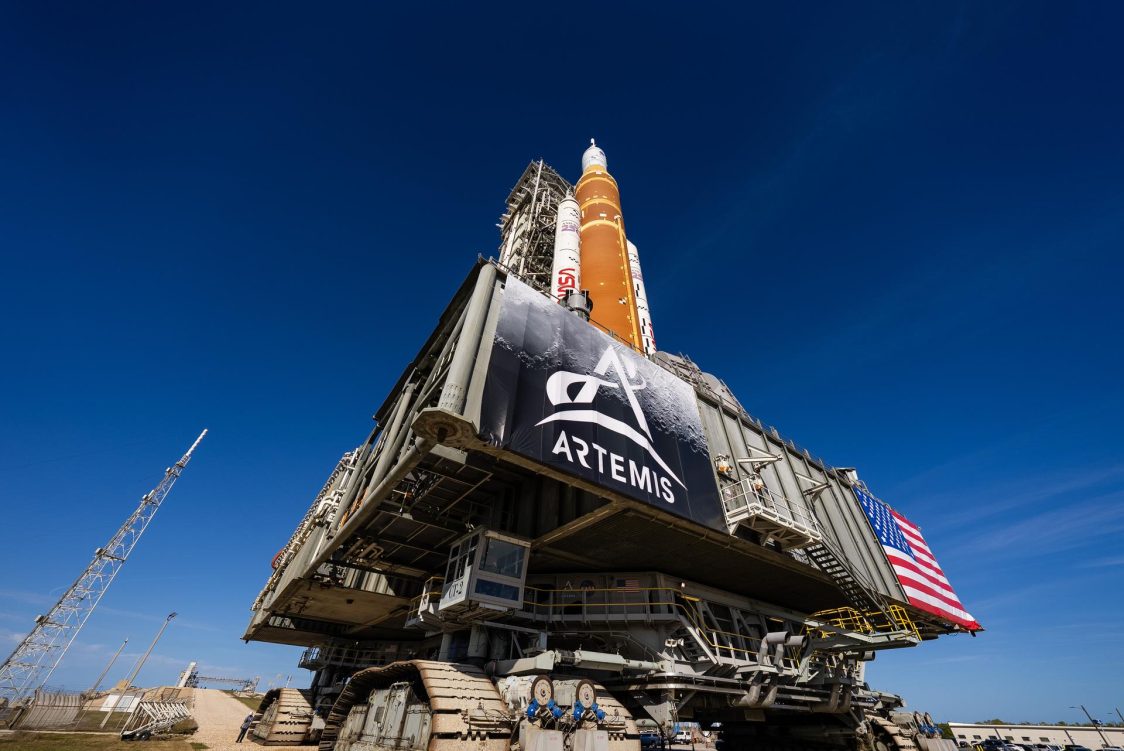
NASA’s Artemis II Space Launch System (SLS) rocket and Orion spacecraft at Launch Complex 39B, Saturday, Jan. 17, 2026, at NASA’s Kennedy Space Center in Florida. (NASA/Sam Lott)
The silence that has settled over the lunar surface for the past fifty-four years is about to be broken. On Launch Pad 39B, the Space Launch System (SLS) stands fueled and ready, a towering testament to a new era of aerospace engineering. Atop this colossus sits Integrity, the Orion spacecraft that will carry four astronauts on a journey redefining humanity's relationship with the solar system.
Artemis II is not merely a sequel to the Apollo program; it is a sophisticated test flight designed to validate the technologies required for a permanent human presence on the Moon. With a launch window opening as early as February 6, NASA is entering the final and most critical phase of its preparations.
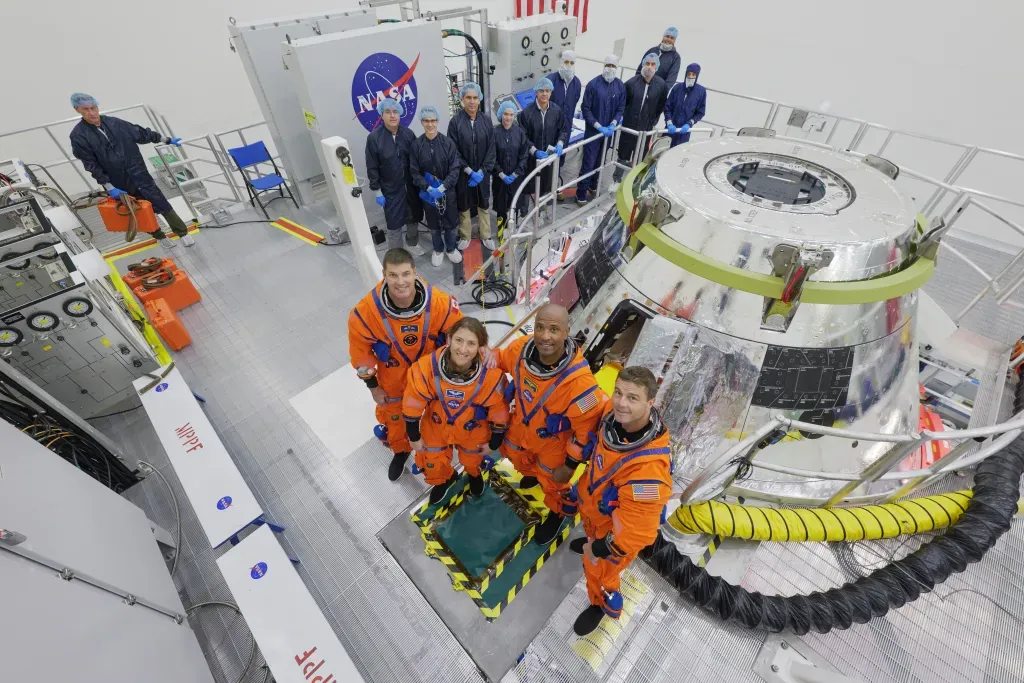
The Artemis II astronauts don their Orion Crew Survival System Suits for a multi-day crew module training beginning Thursday, July 31, 2025 at the agency’s Kennedy Space Center in Florida. Behind the crew, wearing clean room apparel, are members of the Artemis II closeout crew. Testing included a suited crew test and crew equipment interface test, performing launch day and simulated orbital activities inside the Orion spacecraft. This series of tests marks the first time the crew entered their spacecraft that will take them around the Moon and back to Earth while wearing their spacesuits. (NASA)
The Artemis Generation: Meet the Crew
While the hardware is impressive, the heart of Artemis II is its crew. The quartet selected for this assignment represents a significant departure from the demographics of the Apollo era, reflecting a broader, global approach to exploration. They are not just passengers; they are highly trained test pilots and engineers tasked with pushing a new vehicle to its limits.

Artemis II Crew: left Christina Koch, back Victor Glover (pilot), front Reid Wiseman (commander), right Jeremy Hansen
Reid Wiseman (Commander): A decorated naval aviator and test pilot, Wiseman commands the mission. He previously served as a Flight Engineer aboard the International Space Station (ISS) in 2014. His leadership is defined by a "crew-first" mentality, emphasizing that despite the automation of modern spacecraft, the human element remains the critical fail-safe for deep space operations.
Victor Glover (Pilot): Glover is an accomplished pilot who flew the first operational SpaceX Crew Dragon mission to the ISS. On Artemis II, he will become the first person of color to travel around the Moon. His role involves monitoring the spacecraft's manual control qualities during proximity operations in Earth orbit, a vital test to ensure future crews can dock manually with the Lunar Gateway.

Christina Koch (Mission Specialist): An electrical engineer by training, Koch is no stranger to endurance. She holds the record for the longest single spaceflight by a woman (328 days) and participated in the first all-female spacewalks. She will become the first woman to travel to deep space. Her technical background is crucial for troubleshooting the life-support systems that will keep the crew alive inside Integrity.
Jeremy Hansen (Mission Specialist): Representing the Canadian Space Agency (CSA), Hansen is the first non-American to leave low-Earth orbit. A former fighter pilot, his inclusion marks a major geopolitical shift, signaling that lunar exploration is no longer a superpower race but an international coalition. Hansen will oversee the timeline and cargo logistics during the ten-day voyage.
Inside Integrity: The Deep Space RV
The spacecraft carrying this crew represents a massive evolution from its predecessors. The crew has officially named their capsule Integrity, a moniker chosen to reflect the ethical steadfastness required for spaceflight.
Mission Specialist Christina Koch has characterized the vehicle as a "deep space RV." The internal volume is approximately equivalent to two minivans, a space that has been meticulously segmented by engineers. The Commander and Pilot operate the flight controls on the left, while Mission Specialists monitor telemetry on the right.
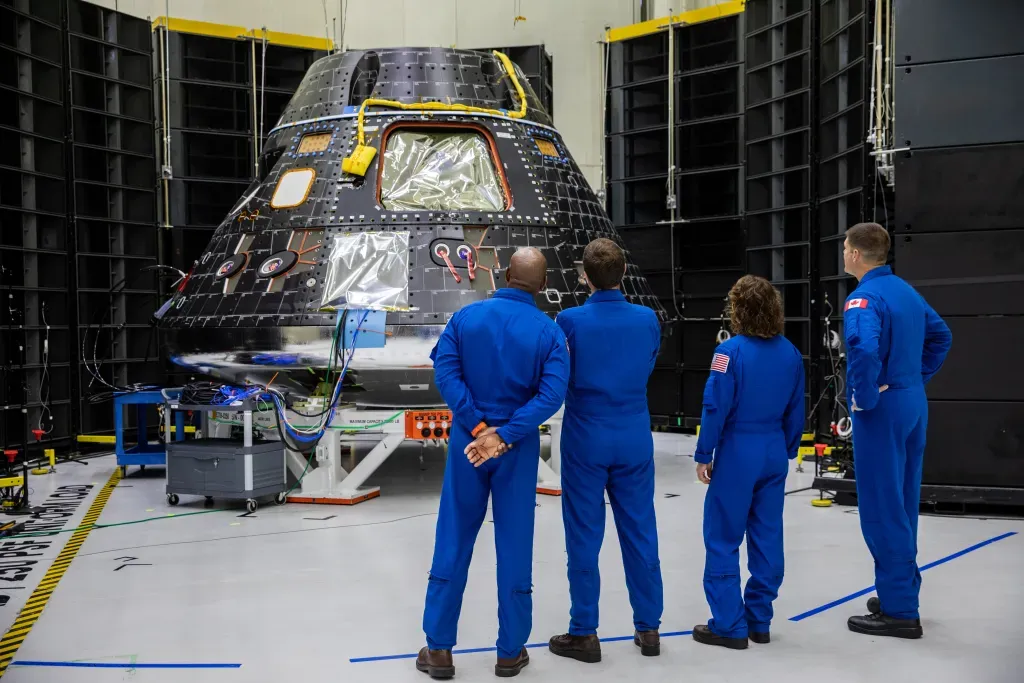
The four astronauts of Artemis II and Integrity. At the time this photo was taken in Aug. 2023, the Orion crew module was undergoing acoustic testing at Kennedy Space Center ahead of integration with the European Service Module. (NASA)
Life aboard Integrity requires a high degree of choreography. The hygiene bay is situated immediately below the main entry hatch. To move between stations, astronauts must navigate over a flywheel exercise device used to maintain muscle mass. This layout reflects a design philosophy where human endurance is prioritized alongside technical redundancy. Commander Wiseman noted that the engineering feels intentionally robust, joking that cables appear "thicker than they need to be" to provide psychological and physical security.

The Heat Shield Strategy
The path to the launchpad has navigated through significant engineering challenges. Following the uncrewed Artemis I mission in 2022, post-flight analysis revealed anomalies in the Orion heat shield. The "Avcoat" thermal protection system, designed to erode in a controlled manner, exhibited unexpected charring and the loss of material chunks during reentry.
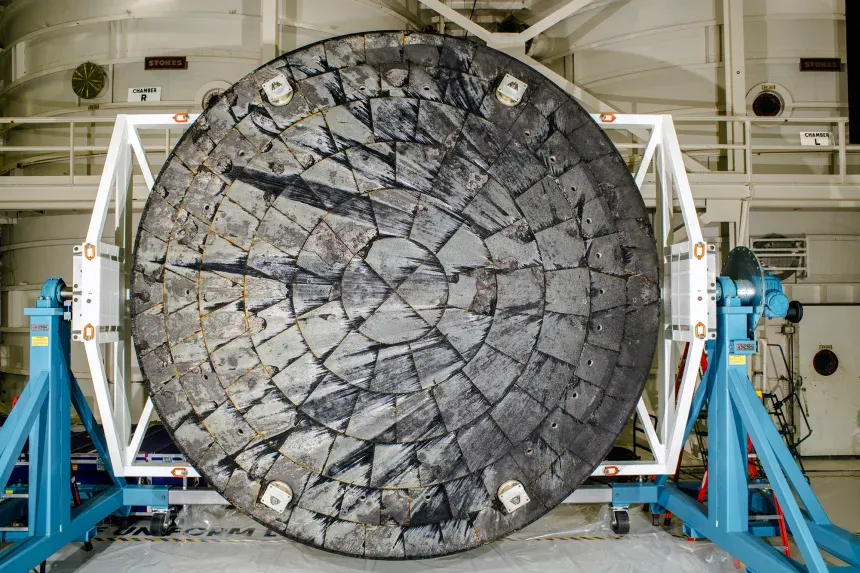
At the conclusion of the Artemis I test flight, the recovered Orion spacecraft was transported to Kennedy Space Center, where its heat shield was removed and inspected. (NASA)
Engineers determined that the manufacturing process had trapped hot gases within the shield, causing the material to fracture rather than ablate smoothly. This discovery presented NASA with a stark choice: strip the capsule to manufacture a new shield (delaying the mission by years) or find a way to fly safely with the existing hardware.

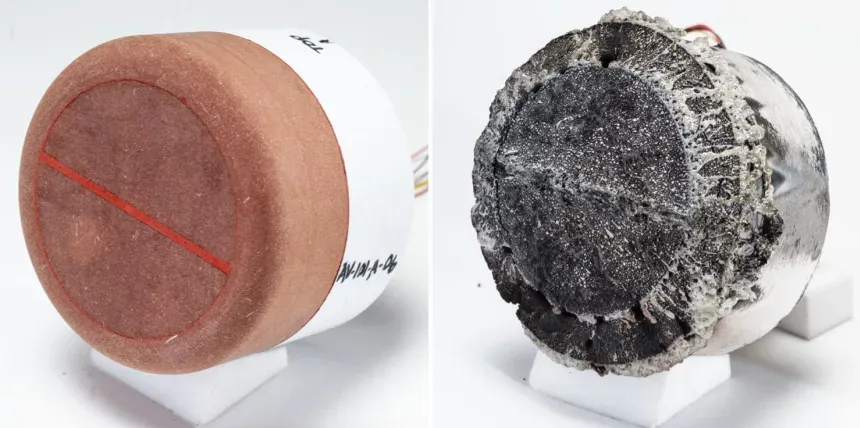
Before and after photographs show test results of heating Avcoat material for 660 seconds. (NASA)
Agency leadership opted for the latter. To mitigate the risk, mission planners have fundamentally altered the reentry trajectory. Integrity will enter Earth's atmosphere on a modified path designed to minimize thermal stress and prevent the gas buildup that damaged the previous shield. NASA officials and the crew have expressed full confidence in this solution, accepting the calculated risk inherent to developmental test flights.
A sample of the Orion spacecraft’s heat shield material undergoes testing in the Laser-Enhanced Arc Jet Facility at NASA’s Ames Research Center in Mountain View, California, in April 2021. (NASA/Ames Research Center)
The Road to the Pad: Repairs and Rollout
The journey to Launch Pad 39B has been paved with intense engineering scrutiny. The massive rocket and spacecraft completed their 4-mile (6.5 km) trek from the Vehicle Assembly Building earlier this month, a rollout that took nearly 12 hours aboard the crawler-transporter.
"We are moving closer to Artemis II, with rollout just around the corner," said Lori Glaze, acting associate administrator for NASA’s Exploration Systems Development Mission Directorate, just prior to the move. "We have important steps remaining on our path to launch, and crew safety will remain our top priority at every turn."
Getting to this point required resolving late-breaking technical hurdles. In December, engineers detected a malfunction in a valve associated with Orion's hatch pressurization. Teams replaced the valve on January 5 and subsequently cleared the system after a successful pressure test. Additionally, ground crews resolved a leak in the support hardware used to load oxygen gas into the capsule.
These repairs were critical to clearing the path for the current phase: the "wet dress rehearsal."
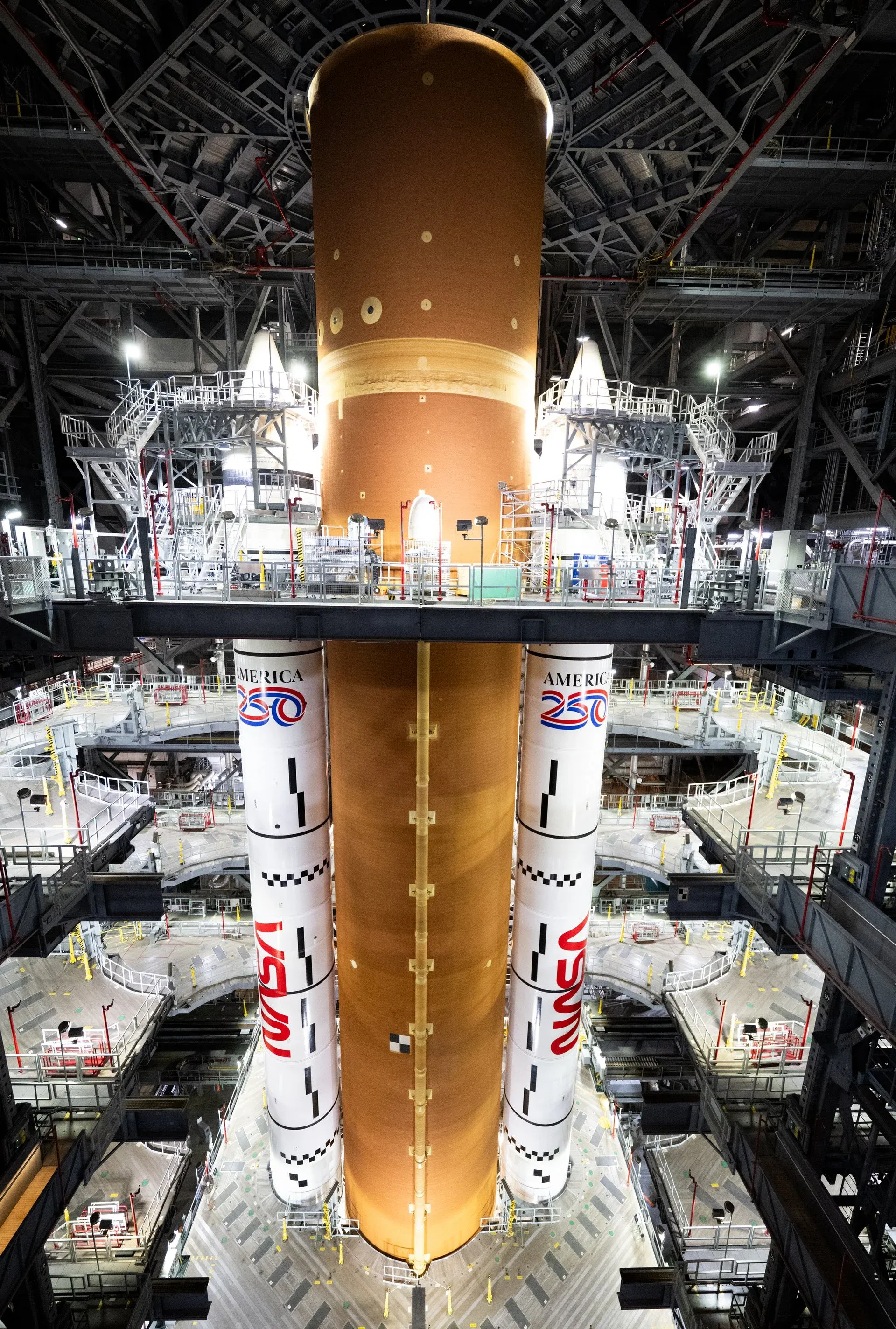
Inside high bay 3 of NASA’s Vehicle Assembly Building at NASA's Kennedy Space Center, the SLS (Space Launch System) for NASA Artemis II stands fully stacked as the retractable platforms pull away. (NASA)
Status Report: The Final Countdown
As of late January 2026, ground teams are executing the final major test before flight. The wet dress rehearsal involves loading the SLS rocket with approximately 700,000 gallons (2.65 million liters) of super-cold cryogenic propellant. The team will run a full launch countdown simulation, practicing the ability to hold, resume, and recycle the count in the final ten minutes, before safely unloading the fuel.

This test is vital for validating updated procedures designed to limit nitrogen gas accumulation between the crew module and the launch abort system—a lesson learned from the Artemis I campaign.
The Launch Window: If the dress rehearsal is successful, NASA targets a launch window opening as early as Friday, February 6. However, orbital mechanics dictate a complex schedule. Due to the alignment of Earth and the Moon, launch opportunities occur in a pattern of approximately one week of availability followed by three weeks of downtime. If the team cannot launch in early February, the window extends through April.
Looking Ahead: Artemis II is the curtain-raiser for the future. Data gathered from this flight, specifically regarding the performance of the heat shield and radiation protection, will directly inform Artemis III. Currently scheduled for 2028, that mission aims to land astronauts on the lunar surface for a 30-day expedition, contingent on the readiness of the Human Landing System.
For now, all eyes are on Integrity and the four astronauts preparing to ride a pillar of fire back to the Moon.